Irish Surnames: Picking out a tartan

Last Sunday I had a great time at the PA Renaissance Faire dancing with the band Tartanic (pictured below for no other reason than the drummers are hot!). After their set, I had a chance to chat with them – one in particular - about tartans. I still had a few questions about them, like which one can I wear if I have several Irish lines.  


The Scottish Register of Tartans states a restriction of one of my ancestral tartans is that it may only be worn by those with that surname. Does this mean that since my maiden name is (clearly not Irish) Ruczhak, that I can not wear my ancestral tartans? 


My grandfather’s mother was a KILPATRICK, born in Ireland. My grandmother was full Irish. Her grandparents – our immigrants – were WALSH, O’FLAHERTY, KEATING, and DURKIN. My DNA results from Ancestry.com show that I am 35% Eastern Europe, 29% Great Britain and 17% Ireland. I also have 14% Scandinavia, 3% Western Europe, 1% Italy/Greece and a trace of European Jewish. The Great Britain DNA is primarily located in Great Britain, Scotland and Wales. The Ireland DNA is primarily found in Ireland, Wales and Scotland. 


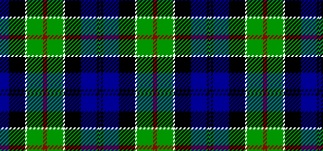
The Kilpatrick tartan is a blue and green plaid. Ironically this is my Protestant line (most Kilpatricks in Ireland are actually Protestant) and the plaid reminds me of my early Catholic School days! According to the website ClanKilpatrick.com, the Kilpatrick surname could be religious or geographic in nature. Kil may have evolved from Gil or Gilla which is Gaelic for servant. Incidentally, my Kilpatrick girls came over as domestics and worked off their passage. However the origin is much nobler. Kilpatrick evolved from MacGillapatricks over the centuries. The original MacGillaptricks were servants of St. Patrick, yes THE St. Patrick! The name also could have derived from a person living near a church dedicated to St. Patrick. 

The Walsh tartan is a Kelly Green with black and yellow running through it. The clan name of Walsh dates back to the 12th century when the Normans of Welsh and English origin showed up in Ireland. It is the fourth most common name in Ireland although it is most common in Counties Dublin, Kerry, Kildare, Mayo and Meath. My grandmother told me her grandfather Michael Walsh, a Catholic, came from Dublin. 

The O’Flaherty Clan is associated with Connemara and the County Galway. The name evolved from Ó Flaithbertaigh, specifically Ua Flaithbertaigh the King of Connacht. It means “bright prince.” Numerous sites offered images of the Family Crest but I was not able to confirm a specific tartan. One was green while another I found was predominantly red. 

I also am descended from the Keating, Durkin, and Murphy lines. Again, how do I – a 3rd/4th generation American – determine which tartan is most appropriate (if any) for me to wear? 


Surname Saturday is a genealogical prompt of GeneaBloggers. 
© Jeanne Ruczhak-Eckman, 2015

Comments

Post a Comment

Popular posts from this blog

52 Ancestors: Anna Keating Walsh is one Tough Woman

Amy Johnson Crow, of No Story Too Small , has challenged us this week with tough women. She asked “ Who is a tough, strong woman in your family tree? Or what woman has been tough to research?” My 2x great grandmother Anna Keating Walsh is indeed a tough woman.   She is a tough woman to trace and I believe she was a tough woman in her time as well. Anna (everyone past my grandparents get actual names; it is the only way I can keep people straight) was born around 1855 in Ireland . According to my grandmother, she was born in County Mayo .   My grandmother had told me that Anna had immigrated with her siblings and that she was the youngest Her parents – Patrick and Knapy Penelope Keating - had stayed behind and she settled in Ringtown which is just a stone’s throw from Shenandoah (assuming of course you can throw a bit)!   She married Michael Walsh and the lived in Shenandoah. The 1910 Census stated Anna had 11 children, with only six living in 1910. I would...

Coatesville's First Serial Killer

Young Alexander Meyer was a disturbed and angry young man with some major issues. He had failed sixth and seventh grade, and instead of having to repeat eighth grade again, he finally gave up on school. At age 16 he quit Downingtown Junior High. Meyer is not a relative, nor are his victims (that I am aware). I stumbled upon young Alex while reading Tortured Minds: Pennsylvania's Most Bizarre - But Forgotten - Murders by Tammy Mal. On 11 February 1937 Alexander Thweatt Meyer killed young Helen Moyer as she walked home from school in Coatesville along Modena Road. She was not his first. The jury was out only three minutes after hearing Dr. Michael Margolis' testimony on the death of Helen Moyer. The jury determined Meyer had murdered Moyer and should be held for first degree murder. The jury also condemned the parole system which had released Meyer back into the public, after having served just 14 months in Huntingdon Reformatory, for the murder of two other girls - Anna Blasc...

Thaddeus Stevens at the Lancaster Convention Center

Within the Lancaster Convention Center (Lancaster, PA) is a small section dedicated to Thaddeus Stevens and Lydia Hamilton Smith. The section is known as the Stevens & Smith Historic Site. It is scheduled for development this year. At the moment one can only get a glimpse of it through the Convention Center or by peeking in from the outside. Here at Queen and Vine Streets in Lancaster City, Pennsylvania, Thaddeus Stevens had his law office. Stevens was an abolitionist. An abolitionist is a person who favors the abolition of a practice or institution, especially capital punishment or (formerly) slavery. Stevens was born 4 April 1792 to Joshua Stevens and Sarah (Sally) Morrill in Danville Vermont. One of four children, he attended Vermont University from 1810 to 1812 when the War prompted its closure. He then went to Dartmouth, where he graduated in 1814. He then studied law and found himself set up in Gettysburg, PA in 1816. He practiced law there until 1828 when he...